Unlocking Creative Potential with Funky Fabric Plaid Seamless Patterns
In the rapidly evolving landscape of digital design, the demand for high-quality, versatile assets has never been higher. Whether you are a seasoned graphic designer crafting a brand identity, a hobbyist looking to personalize scrapbooks, or an educator creating engaging classroom materials, the right visual elements can make all the difference. Among the myriad of digital assets available, Funky Fabric Plaid Seamless Patterns have emerged as a particularly dynamic choice for projects requiring texture, depth, and a touch of retro charm. These digital products offer more than just a pretty background; they provide a foundational element that can elevate simple designs into professional-grade compositions.
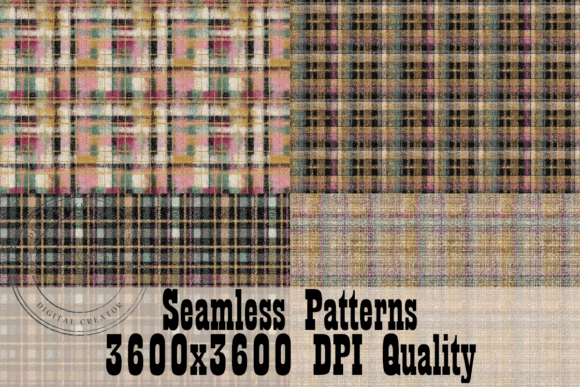
The specific product in question is a set of four distinct seamless patterns, delivered in a convenient instant download format via Creative Fabrica. This collection is designed to bridge the gap between traditional textile aesthetics and modern digital workflows. By understanding the technical specifications and creative applications of these patterns, users can unlock new possibilities in their design processes. The following analysis explores the characteristics, benefits, and practical uses of these 300 dpi PNG files, providing a comprehensive guide for anyone looking to incorporate plaid textures into their work.
The Anatomy of a High-Quality Digital Pattern
To truly appreciate the value of Funky Fabric Plaid Seamless Patterns, it is essential to understand what makes them technically superior to standard clipart or low-resolution images. A seamless pattern is not merely a picture; it is a mathematical tiling system that allows an image to repeat infinitely without visible seams. This property is crucial for designing wallpapers, fabric prints, and wrapping paper, where continuity is key.
- Resolution and Clarity: Each image in this set is rendered at 300 dpi (dots per inch). In the world of print design, 300 dpi is the gold standard for sharpness and detail. This ensures that when your pattern is printed on physical media, such as business cards, flyers, or large-format banners, the edges remain crisp and the colors vibrant. There is no pixelation, even when scaled up significantly.
- Dimensions and Aspect Ratio: The files are provided as 3600×3600 pixel images. This square aspect ratio offers immense flexibility. It allows designers to crop the pattern to various shapes or use it as a full-bleed background without worrying about distortion. At 12 inches by 12 inches at 300 dpi, the file size is substantial enough to hold intricate details but manageable for most modern computers.
- Format Versatility: Delivered in .PNG format, these patterns support transparency if needed, although these particular plaid designs likely feature solid backgrounds. The PNG format is widely compatible with almost all design software, from Adobe Photoshop and Illustrator to Canva and Microsoft PowerPoint. It is important to note that these are raster images, not vectors (SVG) or editable AI files. This means they are fixed pixel grids, which is ideal for texture-heavy designs but requires careful handling if extreme resizing is necessary.
Why Choose Funky Fabric Plaid?
Plaid is a timeless motif, often associated with heritage, comfort, and structure. However, the "Funky" descriptor suggests a modern twist—perhaps bolder colors, unconventional scales, or abstract interpretations of the traditional tartan. This blend of classic and contemporary makes the patterns highly adaptable across different industries.
Versatility Across Industries
The primary advantage of using a pre-made seamless pattern is time efficiency. Creating a tileable vector plaid from scratch requires significant skill in geometry and color theory. By downloading a professionally crafted set, creators save hours of labor. The four variations within the set allow for thematic consistency while providing enough variety to keep a project visually interesting. For instance, one pattern might feature warm autumnal tones suitable for seasonal marketing, while another could use cooler blues for corporate branding.
Texture and Depth
Digital designs often suffer from being too flat. Adding a textured background like a fabric plaid introduces a sense of tactility. Even though the user cannot physically touch the screen, the visual cues of woven fabric trigger a psychological response of warmth and authenticity. This is particularly effective in lifestyle branding, where companies want to appear approachable and human-centric.
Practical Applications and Use Cases
The utility of Funky Fabric Plaid Seamless Patterns extends far beyond simple decoration. Here are several specific scenarios where these assets shine.
Textile and Fashion Design
For aspiring fashion designers or home decor enthusiasts, these patterns serve as excellent starting points. While the files are not vector-based, they can be used as reference textures in software like Procreate or Photoshop to create custom clothing lines. They are perfect for generating mockups of scarves, shirts, or upholstery fabrics. The 300 dpi resolution ensures that the preview looks realistic when presented to clients or manufacturers.
Scrapbooking and Paper Crafts
Hobbyists who enjoy digital scrapbooking or printing physical crafts will find these patterns invaluable. The 12x12 inch dimension is the standard size for many scrapbooking papers. Users can print multiple copies on cardstock to create journals, greeting cards, or gift tags. The seamless nature of the design means that pages can be arranged in any order without disrupting the visual flow of the layout.
Web and UI Design
While heavy textures can slow down web loading times, subtle plaid patterns can be used effectively as hero section backgrounds or sidebars. Because the pattern repeats seamlessly, a small file size can cover a large screen area. Designers can overlay text boxes with semi-transparent backgrounds to ensure readability while maintaining the aesthetic appeal of the underlying plaid.
Packaging and Branding
Small businesses often need cost-effective packaging solutions. Using a unique plaid pattern for tissue paper, stickers, or product labels can differentiate a brand from competitors. The "Funky" aspect allows for playful branding that appeals to younger demographics or niche markets interested in indie aesthetics.
Workflow Integration and Technical Considerations
Integrating these digital assets into a workflow requires a few best practices to ensure optimal results. Since the files are downloaded instantly from Creative Fabrica, the process begins with acquiring the license appropriate for your intended use. Always review the terms of service to ensure compliance, especially if distributing the final product commercially.
Software Compatibility
When opening the 3600×3600 PNG files, ensure your design software is set to display actual pixel dimensions rather than scaled previews. This helps in assessing the true quality of the texture. If you are working in a program that does not natively support seamless tiling, you can manually duplicate the image layer and offset it to check for seams. Most modern tools, however, have built-in pattern brushes or fill options that handle this automatically.
Color Management
The patterns are provided in color, but monitors vary widely in calibration. Before printing, always convert your document to CMYK color mode if you are sending it to a professional printer. RGB colors (used for screens) often appear brighter and more saturated than their CMYK counterparts. Adjusting the brightness and contrast slightly after conversion can help maintain the vibrancy of the funky plaid hues.
Layering Techniques
To maximize the impact of the pattern, consider layering it with other elements. For example, placing a solid-colored shape over the plaid background with a blending mode like "Multiply" or "Overlay" can create complex, multi-dimensional effects. This technique is particularly useful in creating social media graphics where text needs to stand out against a busy background.
Comparing Raster Patterns to Vector Alternatives
A common question among designers is whether to choose raster (PNG/JPG) or vector (SVG/AI) patterns. Both have their place. Vector patterns are infinitely scalable without loss of quality and are editable, making them ideal for logos and large-scale architectural prints. However, they can sometimes lack the organic feel of real-world textures.
Funky Fabric Plaid Seamless Patterns in PNG format offer a distinct advantage in realism. The subtle variations in color and texture that mimic actual fabric weave are often easier to achieve in raster formats. For projects where authenticity and tactile appearance are prioritized over geometric precision, raster patterns are the superior choice. Additionally, raster files are generally smaller in file size than complex vector files, leading to faster load times in web applications and easier management in asset libraries.
Maximizing Value Through Creativity
The true value of a digital asset lies not in its price tag, but in how creatively it is utilized. With a set of four patterns, designers should experiment with mixing and matching. Try pairing two different plaid patterns together using contrasting colors to create a bold, eclectic look. Alternatively, use one pattern as a dominant background and another as a subtle accent border. The possibilities are limited only by the imagination of the creator.
Educators can also leverage these patterns to teach students about design principles such as repetition, rhythm, and balance. By analyzing how the plaid structures interact, students can gain a deeper understanding of composition. Similarly, researchers studying cultural trends in fashion or interior design can use these patterns as case studies in modern reinterpretations of traditional motifs.
Conclusion
In summary, Funky Fabric Plaid Seamless Patterns represent a powerful tool for anyone involved in visual communication. Their combination of high-resolution quality, seamless tiling capability, and versatile aesthetic makes them suitable for a wide range of applications, from digital media to physical print. By understanding the technical nuances of PNG formats and leveraging the creative potential of plaid textures, professionals and hobbyists alike can enhance their projects with minimal effort. As the digital content market continues to grow, having access to high-quality, ready-to-use assets like those available through Creative Fabrica becomes increasingly important for staying competitive and efficient. Embrace the texture, explore the patterns, and let your creativity flow with these dynamic design elements.