Choosing the Right Retro Aesthetic: An Evaluation of Retro Smiley Face Wavy Patterns
In the landscape of digital design, few visual motifs have endured as long or as vibrantly as the smiley face. From its origins in the 1960s to its explosion in pop culture during the 1970s and its recent resurgence in modern graphic design, the smiley has become a universal symbol of positivity. However, not all retro designs are created equal. For designers seeking to capture a specific era’s energy without falling into cliché, the Retro Smiley Face Wavy Patterns collection offers a distinct alternative to standard geometric or typographic retro styles. This article evaluates this specific design set, comparing it against broader categories of vintage-inspired assets to help creators determine if it aligns with their project goals.
Understanding the Design Language
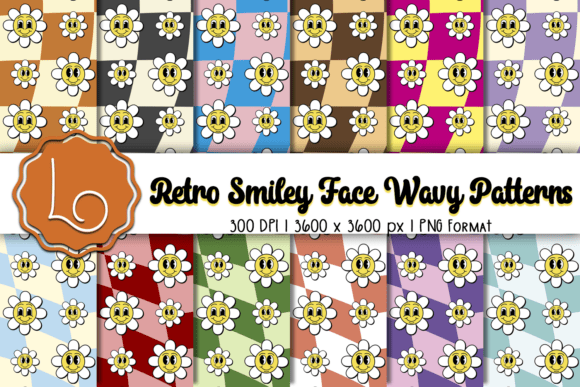
The Retro Smiley Face Wavy Patterns collection is defined by its dual focus on nostalgia and movement. Unlike static clip art or simple vector icons, this set comprises 12 unique digital patterns that integrate groovy smiley faces with fluid, wavy motifs. The "wavy" element is crucial; it references the psychedelic art movements of the late 1960s and early 1970s, where distortion and flow were used to convey altered states of consciousness or simply the fluidity of sound and music.
What distinguishes this collection from generic retro packs is the cohesion between the subject (the smiley) and the structure (the wave). In many budget-friendly or mass-produced pattern sets, these elements feel disjointed—a smiley slapped onto a background of random shapes. Here, the integration suggests a deliberate design philosophy aimed at creating seamless, tileable backgrounds that maintain visual interest even when repeated. For professionals, this distinction matters significantly, as it reduces the need for extensive post-processing to make a pattern look natural.
Technical Specifications and Versatility
When evaluating digital assets, technical specifications often dictate the scope of potential applications. The Retro Smiley Face Wavy Patterns are provided as high-quality PNG files with an optimal resolution of 3600 x 3600 pixels at 300 DPI. This specification places the product firmly in the realm of professional-grade resources rather than casual web graphics.
- Print Readiness: At 300 DPI, these patterns are suitable for high-resolution printing. This makes them viable for physical products such as apparel, fabric designs, pillows, and curtains, where pixelation would be immediately noticeable to the consumer.
- Digital Flexibility: While optimized for print, the PNG format ensures compatibility across various software platforms, from Adobe Illustrator to Canva. The transparency capabilities inherent in PNGs allow designers to overlay these patterns on different base colors or textures, expanding their utility beyond the original file.
Compared to lower-resolution JPEG alternatives often found on freelance marketplaces, the investment in higher-quality source files pays dividends in clarity and sharpness. However, users should note that working with large PNG files can impact software performance on older hardware, a minor trade-off for the superior output quality.
Comparing Approaches: Pattern-Based vs. Element-Based Design
A common decision point for designers is whether to use pre-made patterns or assemble individual elements. The Retro Smiley Face Wavy Patterns represent the former approach. To understand its value, it is helpful to compare it with the "element-based" alternative.
Element-Based Alternatives: Purchasing a pack of individual smiley vectors allows for maximum customization. A designer can resize, recolor, and rearrange each smiley independently. This approach is ideal for complex illustrations where specific placement is required. However, it demands significant time and skill to create a balanced composition. There is also a risk of the final design looking cluttered or unbalanced if the user lacks experience in layout theory.
Pattern-Based Approach (This Product): The Retro Smiley Face Wavy Patterns offer immediate aesthetic cohesion. The hard work of balancing negative space, color harmony, and repetition rhythm has already been done. This is particularly advantageous for:
- Backgrounds: Creating subtle backdrops for text-heavy projects like invitations or website headers.
- Textured Surfaces: Applying a "vibe" to a product mockup without overwhelming the main subject.
- Quick Turnaround Projects: When deadlines are tight, using a proven pattern is more efficient than designing from scratch.
Therefore, the choice depends on the project's complexity. If the goal is a central focal point, individual elements may be better. If the goal is to establish a mood or texture, the Retro Smiley Face Wavy Patterns provide a more streamlined solution.
Ideal Use Cases and Application Scenarios
The versatility of this collection stems from its broad appeal to multiple demographics and industries. Below are specific scenarios where this asset set excels, along with considerations for each.
Apparel and Fabric Design
The wavy, groovy aesthetic aligns perfectly with current trends in streetwear and festival fashion. Because the patterns are seamless, they can be tiled indefinitely across yardage for fabric printing. Designers creating t-shirts, tote bags, or scarves will find that the 3600px resolution ensures the print remains crisp even on large-format printers. A consideration here is color management; ensuring the digital RGB values translate well to the chosen dye-sublimation process is essential for maintaining the vibrancy of the retro palette.
Event Stationery and Digital Invitations
For themed parties—particularly those celebrating birthdays, anniversaries, or summer gatherings—the Retro Smiley Face Wavy Patterns offer instant thematic relevance. They evoke a sense of joy and community associated with the 70s. When used in digital invitations, the lightweight nature of PNGs allows for quick loading times on mobile devices, which is critical given that most invites are viewed on smartphones. For physical prints, the high DPI ensures that details remain sharp on cardstock.
Home Decor and DIY Crafts
The rise of the maker movement has increased demand for printable patterns for sublimation projects, such as custom mugs, phone cases, and decorative pillows. This collection is well-suited for these applications. However, DIYers should be aware that scaling these patterns up for large items (like duvet covers) may require specialized software to manage the tile size effectively. For smaller items like coasters or journals, the patterns fit seamlessly without complex adjustments.
Evaluating Limitations and Tradeoffs
No single asset fits every creative need. It is important to recognize where the Retro Smiley Face Wavy Patterns might not be the optimal choice.
Saturation Risk: The smiley face is a ubiquitous symbol. In markets saturated with similar imagery, using a pattern-heavy approach can sometimes contribute to visual noise rather than clarity. If a brand identity relies on minimalism or serious corporate messaging, this playful, groovy aesthetic may clash with the desired tone. It is best reserved for projects aiming for fun, nostalgic, or youthful vibes.
Color Constraints: While the PNG format supports transparency, the patterns themselves come in fixed colorways within the set. If a designer needs a monochromatic version or a completely different hue scheme that isn't included in the 12 variations, they will need additional editing skills to alter the colors manually. Compared to fully editable vector formats (like AI or EPS), PNGs offer less flexibility for deep structural changes, though they are easier to use for general application.
Decision Framework: Is This Right for You?
To decide whether to incorporate the Retro Smiley Face Wavy Patterns into your workflow, consider the following checklist:
- Do you need seamless tiling? If yes, this collection is highly rated for its coherence.
- Is your project print-oriented? The 300 DPI resolution meets professional standards for textiles and paper goods.
- Are you short on time? Using pre-designed patterns accelerates the production process compared to building compositions from individual vectors.
- Does your audience respond to nostalgia? The 70s-inspired wavy motif appeals strongly to millennials and Gen X audiences, while also attracting younger demographics interested in "retro-chic" aesthetics.
If your answer to these questions leans toward "yes," this collection represents a strong value proposition. It bridges the gap between casual fun and professional quality, offering a resource that is both aesthetically pleasing and technically robust.
Conclusion
The Retro Smiley Face Wavy Patterns collection stands out in a crowded market of digital assets by combining high-resolution technical specs with a cohesive, era-specific aesthetic. It serves as a practical tool for designers who want to inject warmth and nostalgia into their work without sacrificing professionalism. Whether used for commercial apparel lines, personal scrapbooking, or digital marketing materials, these patterns provide a reliable foundation for creative expression. By understanding the strengths of pattern-based design and recognizing the specific niche this collection occupies, creators can make informed decisions that enhance the emotional impact of their projects.